The Gaps I Filled In
On phones, boredom, and the small resets I stopped giving myself
I once answered a work question from the bath. Someone needed something looked at, something that could comfortably have waited until the morning, and I read the message and replied to it one-handed whilst sitting in water, at the end of a day I had already told myself was finished. I do not remember resenting it. If anything I remember a small satisfaction at having dealt with it, because dealing with things was where I had quietly stored my sense of being worth something, and it did not occur to me for a long time afterwards that the noteworthy part of that evening was not the message at all but the fact that there was no longer anywhere in my life that a message could not find me.
The gaps that used to be there
There used to be small pockets of my day where nothing happened. Waiting rooms with a stack of magazines nobody had chosen. Queues. The thirty seconds in a lift. Standing in a tube station, or in the kitchen whilst the kettle boiled. None of these were pleasant exactly, and I would not want to romanticise them, because at the time they mostly registered as mild irritation at being made to wait. But they were unfilled, and being unfilled turned out to be the whole point of them.
I cannot remember the last time I stood in a queue and simply stood in it.
The mechanics of this are worth spelling out, because for years I assumed the phone was a neutral thing I happened to be holding. Those unfilled pockets were where a certain amount of processing used to happen without me arranging it. A conversation from earlier in the day would surface and I would turn it over a bit. A worry would arrive with nothing to compete with it and get some air. A feeling I had been carrying since the morning would finally be noticed, and quite often it would turn out to be smaller than it had felt when it was ignored. I would not dignify it with a word like reflection; it was my brain doing housekeeping in the spare moments it had been given, the way it presumably always had.
What I have now instead is a device that arrives in my hand before I have registered what I am feeling. Everybody says they are on their phone too much, usually in a jokey voice, and I have said it in that voice myself. What I mean is less comfortable than that. The reach is fastest precisely when something difficult is starting, which means it is at its most automatic in exactly the moments that used to do me the most good: the awkward silence after a conversation that has not gone well, the first minute of lying down at night. The phone does not remove the feeling. It postpones it, indefinitely, at no obvious cost, which is how the bill ends up so large.
Everything pours into the glass whether or not I have noticed it, and I had already spent years being very good at not noticing, so filling in every last gap where noticing might have happened by accident removed the only draining that was still going on without my permission.
An answer for everything
For someone with an anxiety disorder there is a second problem on top of that one, and I think it is the more serious of the two.
The wiring I came away with after the concussion was, at bottom, a rule about uncertainty: uncertainty is intolerable and must be resolved by checking. For most of human history that rule ran into physical limits fairly quickly. You could not look anything up at two in the morning. If you were worried about a symptom you had to wait for an appointment, and the waiting was miserable, but the waiting also meant that a good proportion of worries quietly expired before you had any way of feeding them. The limits were not kind, exactly, but they were limits.
Now I carry, at all times, a machine that will answer any question I can phrase, instantly, at any hour, and it will never once suggest that I have had enough. A sensation in my chest, and inside a minute I have read three pages about what it might mean, one of them reassuring and one of them not, and it is reliably the one that is not that stays. Then a second search designed to cancel out the first. Then the same question typed a slightly different way, in case the wording had been the problem. I have described this pattern before as hypervigilance wearing a lab coat, and what I did not appreciate at the time is how much of it was only possible because of the device. The phone did not give me the need for certainty. It gave me somewhere to take that need forty times a day, which is a different thing and in some ways a worse one.
Each search feels, in the moment, like it will lower the level in the glass. It pours more in. Reassurance never actually arrives, because there is always another page, and the internet cannot tell you that you are fine in a way that stays said.
What I did to my attention
The clearest evidence is in the things I can no longer do properly. I read a page of a book and get to the bottom of it having taken in none of it, and have to go back to the top, and sometimes do that twice. I watch a film with the phone face down beside me, which I tell myself is a compromise, and then check something halfway through and lose a scene I will not get back. If I described this pattern to someone with no context at all it would sound like attention deficit, and I want to be careful here, because ADHD is a real condition with a real mechanism and I am not suggesting that what I have done to myself is the same thing. What I am describing is smaller and more embarrassing. I trained a capacity out of myself. I spent something like a decade teaching my brain that any moment of low stimulation could be topped up immediately, and it learned, thoroughly and obediently, because learning from repeated experience is the one thing brains reliably do.
I have written before about wiring, and about how the behaviours that feel most like personality are usually lessons taken from experiences nobody was labelling as lessons at the time. This is the same process, except that I ran the training myself, several hundred times a day, for years, and paid for the equipment.
For a long while I assumed the answer was to identify the guilty app. So I took the social media off. Facebook first, then Instagram, then X, then Threads for the short period I could be bothered with it, and TikTok, which I had never really got the hang of anyway. I expected to get something back.
What actually happened is that my thumb kept travelling to the same corner of the screen and found something else to land on. News apps, of which there is an infinite supply and which are built to be alarming. LinkedIn, which I would not have described as entertainment at any point in my life and which I nonetheless scrolled, at length, in the evenings. That was the useful and faintly humiliating discovery, and it is the reason I am now planning something more drastic. I was never attached to the content. Nobody’s holiday photographs or professional milestone had any hold over me at all. What I was attached to was the mechanism, the small pull of something new arriving, and the mechanism does not care what it is attached to; it will settle on whatever is nearest with a feed. Deleting apps one at a time was always going to fail, because I was removing individual sources of an appetite I could apparently satisfy with almost anything.
Always on
Work is where all of this became something more than a bad habit. At some point I put Slack on my phone, and I want to be honest that nobody made me do it and that I would have defended the decision if challenged. Being reachable felt like being reliable. Being reliable was the identity I had built and the thing I was most afraid of losing, so a small icon that let me be reliable at any hour looked less like a risk than like an advantage.
What it actually did was remove the edge of the day. The working day used to end at a definite point, and after that whatever was going on at work was simply out of reach, and I would not claim any credit for that, because it was the technology of the time enforcing a boundary I had not the slightest intention of setting myself. Once it was on my phone the day stopped ending. It tapered. It went quiet for a while and then said something at nine in the evening, and the fact that most of what it said was unimportant is exactly the problem, because I could not know which category a message fell into without looking, and so I looked, and each look was a small pour into a glass I already could not keep on top of.
Then consider what that does to a nervous system that has already tipped into hypervigilance. I have described that state as a smoke alarm that will not stop ringing, a system that has concluded the threats are constant and has therefore stopped switching off. I was carrying, in my pocket, a machine that set the alarm off on purpose, several times an hour, on a schedule I could not predict, with a genuine emergency in there often enough to make ignoring it feel irresponsible. I would put the phone down and my hand would be back on it inside a minute, with no real expectation of finding anything, because checking had become the way I discharged a feeling I had stopped being able to name. Scanning my inbox for danger, which I once listed as a symptom of my worst period, was also just a thing I did in lifts.
Not just me
The thing that has surprised me most is how little of this turns out to be personal.
Almost everyone I have talked to about it describes the same experience, often in nearly the same words. People with no anxiety disorder and no mental health difficulty they would ever name say that they cannot read the way they used to, that they cannot get through a film without picking the phone up, that they find it in their hand without having decided to fetch it. I have raised it with a lot of people at this point, some of them privately after last year, and I can count on one hand the ones who said it was not like that for them.
There is a wider picture too, and I want to put it in front of you carefully, because it is the sort of thing that gets waved around badly. Diagnosis rates for mental health conditions have risen a great deal, particularly among the young. In England the proportion of eight to sixteen year olds with a probable mental disorder went from 12.5 per cent in 2017 to 20.3 per cent in 2023, and at the end of the 1990s the equivalent figure for children was under ten per cent. Over broadly the same period the smartphone went from a device that about a quarter of British adults owned in 2011 to one that more than eight in ten were using by 2020.
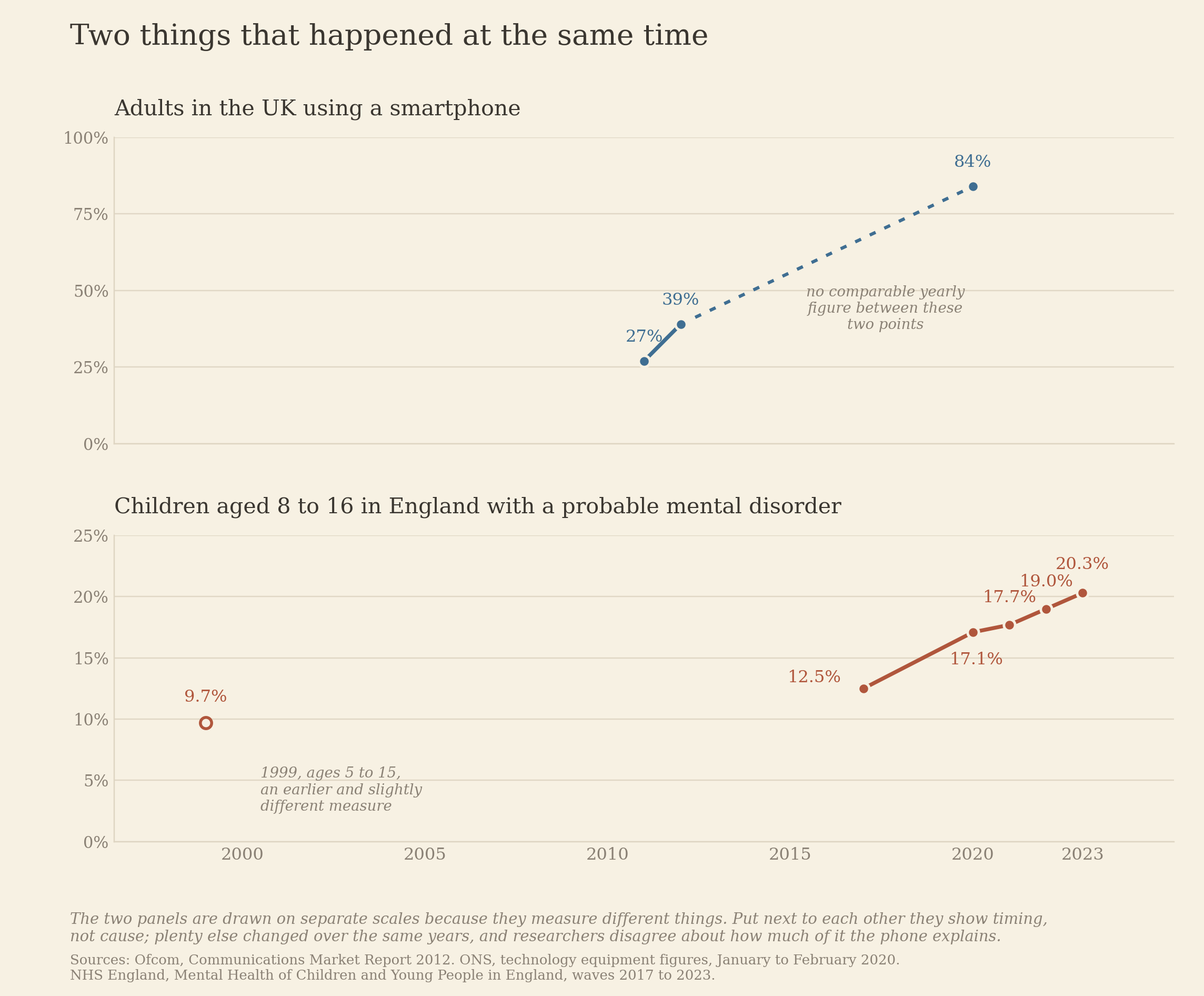
Put those two next to each other and the shape is difficult to unsee, and I notice that I want the chart to prove something, which is exactly the point at which I ought to slow down. Two lines rising over the same years is not evidence that one caused the other. Willingness to report symptoms and seek a diagnosis rose over that period as well, the surveys themselves changed, and a pandemic sits in the middle of the data doing who knows what to it. Researchers who have spent their careers on this genuinely disagree about how much of the rise the phone explains, and anyone presenting it as settled is usually selling you something, which is a thing I have learned to notice since I stopped taking my questions to the search bar. Persuasive and true are not the same, and a chart is mostly good at the first one.
What I can say with real confidence is the smaller claim, the one about me. Whatever turns out to be true at the population level, in my own case the phone did not create the anxiety and it did not cause the overflow, but it made an existing disorder enormously easier to feed, and it removed the small dull moments in which I might have noticed I was doing it.
What I am going to try
I have decided to run an experiment, and I am writing about it before I begin partly so that I will actually go through with it. I am going to take my iPhone and strip it back until it does the few things a phone genuinely needs to do and almost nothing else, then keep it that way long enough that the novelty of both the restriction and the rebellion wears off, and see what is left. Given that removing the apps one by one only taught my thumb to find something else, it seems clear that whatever I do has to happen at the level of the device rather than the level of the app.
I am not doing it because I think phones are evil, or because I have found an answer and want to sell it to anyone. I suspect the gaps I filled in were doing more work than I ever gave them credit for, and the only way I know to test that is to open some of them back up and find out what turns up.
If any of this sounds familiar, what I would offer is smaller than a rule about screen time, because I have set those and quietly overridden them within a fortnight and I doubt I am unusual in that. Try noticing the reach itself, once or twice a day, and what was going on in the half second before your hand moved. And if you have already deleted something and found yourself somewhere unexpected instead, on a news app at midnight or reading about the promotions of people you have not spoken to in nine years, that is worth knowing rather than worth being ashamed of. You do not have to stop, and you certainly do not have to add this to the list of things you are failing at, because that list is heavy enough already and the reaching is information rather than a verdict. Just notice what it is that keeps arriving immediately before the phone does.
I will report back honestly on the experiment, including if it goes badly, which I think is a real possibility. What I am least sure about is not whether I can manage without the apps for a few weeks. It is what I will find in the queue.
Get new posts by email — no noise, just the writing.
Subscribe on Substack← Writing · Andy Bridson