When the Glass Overflows
Anxiety did not arrive one day fully formed. It had been quietly assembling itself since I was young.
I have come to understand that my anxiety did not arrive one day out of nowhere, fully formed and uninvited, but was instead something that had been quietly assembling itself since I was young, built from experiences and the lessons I took from them without ever realising I was learning anything at all. My first real encounter with it came after a concussion, when the pain refused to fade the way I had been told it would, and over the six months that followed I became convinced that something far more sinister was going on, that the persistent ache in my head could only mean a brain tumour. Every twinge became evidence, every headache a confirmation, and although the tumour never existed, the lesson my nervous system took from those six months absolutely did. I had taught myself, thoroughly and without meaning to, that my body could not be trusted, that pain meant catastrophe until proven otherwise, and that the correct response to uncertainty was to monitor, to check, and to worry.
These learned behaviours are the foundation, the predisposition, the soil in which everything later grows. Nobody sits you down and teaches you to scan every sensation for what might go wrong; you learn it in episodes like that one, and by the time you are old enough to notice the pattern, it feels less like a habit and more like who you are. I say this not to dwell on one frightening period but because understanding where the wiring came from was the first step in realising that it was wiring at all, and not simply my personality carved in stone.
The stress glass
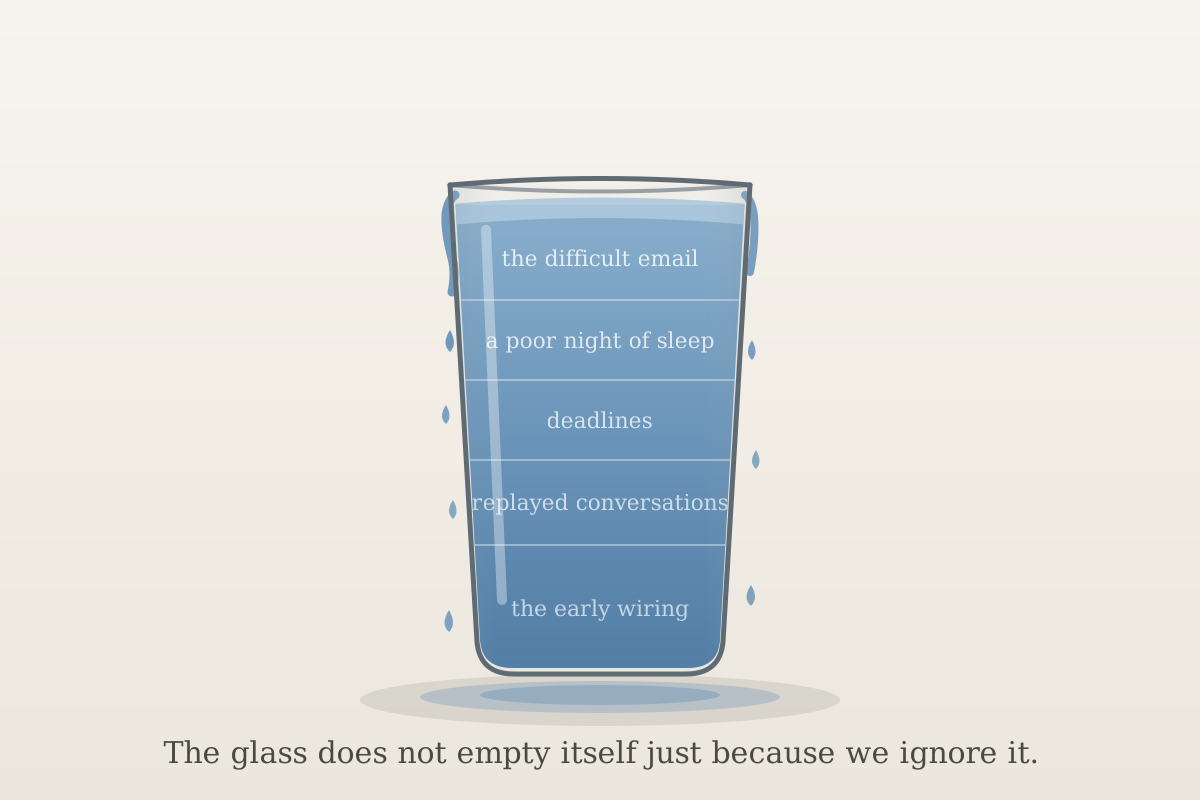
The analogy that finally made sense of it for me is a simple one. Imagine that each of us carries a glass, and into that glass goes every stress we encounter; the big obvious ones like bereavement or money worries, but also the small and almost invisible ones like a difficult email, a poor night of sleep, a skipped lunch, a conversation we replayed on the drive home. The glass has a finite capacity, and crucially it does not empty itself just because we ignore it. Some people start each day with a glass that is nearly empty, and they can absorb a great deal before anything spills. Those of us with the early wiring I described start with a glass that is already half full before we have even had breakfast, filled by years of accumulated vigilance and old lessons about what the world requires of us.
For a long time you can get away with it. The glass fills, and it drains a little at weekends or on holiday, and it fills again, and you tell yourself this is simply what being a functioning adult feels like. But a glass that is always three quarters full has very little room left, and it only takes a small pour, something that would barely register for someone else, for it to overflow.
Worth measured in output
Here is where my particular personality made everything worse, because somewhere along the way I had concluded that my value as a person was driven almost entirely by my productivity. If I was useful, if I was delivering, if I was the reliable one who got things over the line, then I was worth something, and if I was not producing then I was, in some unexamined way, failing at the basic task of justifying my existence. I suspect a lot of people reading this will recognise that equation even if they have never written it down, because our culture rewards it; the person who ties their worth to their output tends to get promoted, praised and leaned upon, right up until the moment they cannot do it any more.
The cruel mechanics of this are worth spelling out. If your worth equals your productivity, then rest feels like a deduction from your value rather than an investment in it, and so you do not rest, and so the glass never drains, and so the very belief that makes you work harder is the same belief that removes your only means of recovery.
The overflow
For me it happened at work, as I imagine it does for many people, because work is where the productivity equation gets tested daily. The demands crept up gradually, as they do, and I responded the only way I knew how, which was to absorb more, work longer, and reassure everyone including myself that I was fine. I was becoming overwhelmed and I genuinely could not see it, because overwhelm from the inside does not feel like a warning light; it feels like everyone else’s fault, or like a temporary busy patch, or like evidence that you need to try harder.
And then the glass overflowed. Not with a dramatic crash but with a tipping, an almost audible click, into a state I would later learn is called hypervigilance. My nervous system, having decided that the threats were now constant, stopped bothering to switch off at all. I noticed my own heartbeat. I scanned my body for symptoms and my inbox for danger. Sounds were louder, sleep was shallower, and my mind treated every sensation and every task as a potential emergency requiring immediate analysis. If you have never experienced it, the best description I can offer is that it is like a smoke alarm that has decided the safest policy is to simply never stop ringing.
How I made it worse
What I did next is the part I most want to be honest about, because I suspect it is the most common trap of all. Faced with a mind that would not switch off, I reached for the two tools my wiring had given me, and both of them poured more into the glass.
The first was work itself. Working harder had always been my answer to everything, and it had the added advantage of being a distraction; if I was buried in tasks I did not have to sit with the frightening static in my own body, and so I worked more, told myself I was coping, and quietly fed the very overload that had tipped me over in the first place.
The second was research. I turned my productivity engine on the problem of my own anxiety, and I researched it the way I would research a project at work, hours of articles and forums and videos, searching for the cure, the technique, the supplement, the one explanation that would fix me. It felt responsible and proactive, but in truth it was hypervigilance wearing a lab coat. Every hour spent scanning for cures was another hour spent telling my nervous system that there was indeed a serious threat that needed constant monitoring, and every contradictory article gave the alarm something new to ring about. I was trying to think my way out of a state that thinking had built.
What I would tell you
If any of this sounds familiar, I want to offer you the things I wish someone had said to me at the start. Your anxiety is not a character flaw and it is not random; it is a learned response, assembled from real experiences, which means it can be understood and, slowly, unlearned. Your glass is not a measure of your weakness, it is simply a glass, and the work is not to be ashamed of its level but to learn what genuinely drains it, which in my experience is rest without guilt, movement, honest conversation and time, rather than another late night of research. And your worth was never your productivity. That one takes the longest to believe, and I am still practising it, but the day I first managed to rest without apologising for it was the day the level in the glass finally, fractionally, began to fall.
I will write more about what unlearning has actually looked like in the posts to come. For now, if your glass feels close to the brim, please treat that as information rather than failure, and be gentler with yourself than your wiring wants you to be.
Get new posts by email — no noise, just the writing.
Subscribe on Substack← Writing · Andy Bridson